Pouget's extensive earlier work . . . suggested the human brain is wired naturally to perform [statistical] calculations. . . ."We've been developing and strengthening this hypothesis for years�how the brain represents probability distributions," says Pouget. "We knew the results of this kind of test fit perfectly with our ideas, but we had to devise a way to see the neurons in action. We wanted to see if, in fact, humans are really good decision makers after all, just not quite so good at doing it consciously. . . . It's weird, but people rarely make optimal decisions when they are told the percentages up front." . . .
Shadlen's team watched the activity of a pair of neurons that normally respond to the sight of things moving to the left or right. For instance, when the test consisted of a few dots moving to the right within the jumble of other random dots, the neuron coding for "rightward movement" would occasionally fire. As the test continued, the neuron would fire more and more frequently until it reached a certain threshold, triggering a flurry of activity in the brain and a response from the subject of "rightward."
Pouget says a probabilistic decision-making system like this has several advantages. The most important is that it allows us to reach a reasonable decision in a reasonable amount of time. If we had to wait until we're 99 percent sure before we make a decision, Pouget says, then we would waste time accumulating data unnecessarily. If we only required a 51 percent certainty, then we might reach a decision before enough data has been collected.
Monday, December 29, 2008
Our Unconscious Brain Makes The Best Decisions Possible
Fascinating study about the probabilistic operation of our unconscious.

Educating Goldfish: Multiple Lines of Intelligence Evolution
From Scientific American:
As is the case with many traits�complex brains and sophisticated cognition have arisen multiple times in independent lineages of animals during the earth�s evolutionary history.
Wednesday, December 24, 2008
G�ndara and Contreras: Rescuing the American Dream
I just finished the new book, The Latino Education Crisis: The Consequences of Failed Social Policies, by Patricia G�ndara and Frances Contreras (HUP, out in January). Written in an accessible style but with copious footnotes and references for those so inclined, the book documents where we are now, and where we might go, in our education, and care of, the Latino population. Fast-growing and largely neglected, this population's characteristics are documented in the book with charts, tables, statistics, and heart-wrenching stories about dreams deferred and aborted. I was particularly struck by the portraits the authors make of a number of Latino and Latina youths who overcome barriers, and of those who do not.
In the last few pages of the book, G�ndara and Contreras outline a policy agenda to address the need.
In the last few pages of the book, G�ndara and Contreras outline a policy agenda to address the need.
- Better health care and access to social services
- Subsidized preschool programs
- Housing desegregation and stabilization initiatives
- Target recruitment and better preparation for teachers
- Immigration policy reform
- Support for dual-language education
- Dropout prevention and college-access programs that support the connection between school and home
The buzz on this book is palpable, and I expect it to be discussed and widely reviewed. I have tapped one of my colleagues to review it for Education and Culture.
Tuesday, December 23, 2008
Revisiting the Moynihan Report
The Moynihan Report Revisited: Lessons and Reflections after Four Decades
Summary
Summary
- Douglas S. Massey and Robert J. Sampson
-
The ANNALS of the American Academy of Political and Social Science 2009 621: 6-27.[PDF] [References] [Request Permission]
- James Q. Wilson
-
The ANNALS of the American Academy of Political and Social Science 2009 621: 28-33.[PDF] [References] [Request Permission]
- William Julius Wilson
-
The ANNALS of the American Academy of Political and Social Science 2009 621: 34-46.[PDF] [References] [Request Permission]
- Harry J. Holzer
-
The ANNALS of the American Academy of Political and Social Science 2009 621: 47-69.[Abstract] [PDF] [References] [Request Permission]
- Devah Pager and Diana Karafin
-
The ANNALS of the American Academy of Political and Social Science 2009 621: 70-93.[Abstract] [PDF] [References] [Request Permission]
- Frank F. Furstenberg
-
The ANNALS of the American Academy of Political and Social Science 2009 621: 94-110.[Abstract] [PDF] [References] [Request Permission]
- Sara McLanahan
-
The ANNALS of the American Academy of Political and Social Science 2009 621: 111-131.[Abstract] [PDF] [References] [Request Permission]
- Linda M. Burton and M. Belinda Tucker
-
The ANNALS of the American Academy of Political and Social Science 2009 621: 132-148.[Abstract] [PDF] [References] [Request Permission]
- Kathryn Edin, Laura Tach, and Ronald Mincy
-
The ANNALS of the American Academy of Political and Social Science 2009 621: 149-177.[Abstract] [PDF] [References] [Request Permission]
- Andrew Cherlin, Bianca Frogner, David Ribar, and Robert Moffitt
-
The ANNALS of the American Academy of Political and Social Science 2009 621: 178-201.[Abstract] [PDF] [References] [Request Permission]
- Frank D. Bean, Cynthia Feliciano, Jennifer Lee, and Jennifer Van Hook
-
The ANNALS of the American Academy of Political and Social Science 2009 621: 202-220.[Abstract] [PDF] [References] [Request Permission]
- Bruce Western and Christopher Wildeman
-
The ANNALS of the American Academy of Political and Social Science 2009 621: 221-242.[Abstract] [PDF] [References] [Request Permission]
- Lawrence D. Bobo and Camille Z. Charles
-
The ANNALS of the American Academy of Political and Social Science 2009 621: 243-259.[Abstract] [PDF] [References] [Request Permission]
- Robert J. Sampson
-
The ANNALS of the American Academy of Political and Social Science 2009 621: 260-280.[Abstract] [PDF] [References] [Request Permission]
- Ron Haskins
-
The ANNALS of the American Academy of Political and Social Science 2009 621: 281-314.[Abstract] [PDF] [References] [Request Permission]
Academic Freedom "at Risk?"
An article in today�s Inside Higher Education, �Speech Restriction Draw Fire,� details a plan at Northeastern Illinois University to require protesters to submit copies of fliers and signs to administrators two weeks before they can be displayed on campus (http://www.insidehighered.com/news/2008/12/23/speech). Back in September we learned that the University of Illinois has sent an email to all employees (including faculty) that forbade displaying bumper stickers or political buttons on campus unless they were non-partisan (http://www.insidehighered.com/news/2008/09/24/buttons). A few weeks later the University of Austin was forced to rescind an order that no posters be displayed in students� dorm windows, including campaign posters, after both Obama and McCain supporters with the help of the ACLU challenged the rule. All of this comes on the heels of David Horowitz�s continuing Academic Bill of Rights campaign to protect students from �liberal� and �radical� professors who are attacking our students with their sinister ideas.
These are just a few recent examples of attempts to undermine the academic freedom that we have fought so hard for over the years. We could add the various tenure decisions that have been questioned, the professors who have been reprimanded or fired for having unpopular or controversial ideas, the famous UCLA Dirty Thirty list, and countless other examples of schools that have fallen prey to the right-wing plan to clean our schools of �subversive,� read divergent or counterhegemonic, ideas.
When did ideas become so dangerous? This has certainly always been the case to those in power. From our earliest days, the control of information stands at the forefront of the war to control what we see, hear and think. As a World Bank draft report (2003) argued, �unions, especially teachers union, are one of the greatest threats to global prosperity.� This is the new conventional wisdom � teachers and, of course, teachers unions, undermine the central tenants of neoliberalism by getting people to, gulp, think about the world order and its logic and fairness. The progenitors of official knowledge want to delimit the available voices in the public sphere and continuously attack the last bastion of free thought and serious inquiry.
Faculty have generally challenged this call for censorship, as well as the false call for objectivity and neutrality. The minor successes of David Horowitz�s Academic Bill of Rights, however, show the ways in which colleges and universities have increasingly embraced the idea that knowledge is implicitly dangerous and that we must protect students from radical teachers and their attempts to proselytize students. The situation in k-12 public schools is of course more tenuous, as calls for neutrality and politics-free curriculum seem to increasingly be the rule. From NCLB, Adoption Plans and scripted curriculum to positivism�s stronghold on educational research, we move closer and closer to the notion that education and knowledge are purely instrumental � a means toward the end of training, profits and a compliant, complacent workforce.
An interesting recent article from the New York Times, however, suggests that the power of professors to change their students� minds is quite limited: http://www.nytimes.com/2008/11/03/books/03infl.html?_r=1&ei=5070&emc=eta1&pagewanted=print. The article cites three recent studies that find that professors have virtually no influence on the political ideas of their students. Parents, family and, to a lesser extent friends, are the major influence on politics ideas � particularly among the young. While schools once caused many students to rethink their ideas, this appears to be the case less and less (while many of my own student�s claim I awaken them to new ideas, and some do seem to really question their preconceived notions, few actually seem to change their general views on race, class, power, language, etc.) Why? I would argue that it has a lot to do with the stifling of real debate, the positivistic meme that has overtaken American scholarship and the popular idea that knowledge can even be neutral or apolitical.
Decades of challenges to this idea from history, anthropology, linguistics and political and social theory in general have appeared to go largely unheeded (at least outside the Ivory Tower). In my view, people tend to relate knowledge to their own experiences and the ideas that surround them throughout civil society. Schools are one of the few places where these questions are asked in a serious, critical manner (directive learning). And yet these spaces have been attacked so effectively in recent years that one wonders if the closing of the American mind is in fact inuring.
I believe our first responsibility as teachers, professors and educators at all levels is to open our student�s minds to the richness of knowledge and ideas. We must challenge our students to question not only conventional wisdom but their own deeply held beliefs � no matter where they fall on the political spectrum. This does not mean proselytizing them or making them think like us, it means giving them the tools to critically reflect on their own experiences and their relationship to the broader social, economic and political worlds in which they reside. If schools fail to provide this most basic aspect of learning, they do a disservice not only to students but society at large. As Dewey, Jefferson and Freire among countless others have argued, democracy depends on an educated, informed populace, with the freedom to explore divergent perspectives. I think we as professors should take this as a central charge and attack all efforts to undermine our freedom to explore knowledge in all its richness and diversity. This includes attacking the popular notion that knowledge is implicitly dangerous and that we must protect students from it.
-- Richard Van Heertum
These are just a few recent examples of attempts to undermine the academic freedom that we have fought so hard for over the years. We could add the various tenure decisions that have been questioned, the professors who have been reprimanded or fired for having unpopular or controversial ideas, the famous UCLA Dirty Thirty list, and countless other examples of schools that have fallen prey to the right-wing plan to clean our schools of �subversive,� read divergent or counterhegemonic, ideas.
When did ideas become so dangerous? This has certainly always been the case to those in power. From our earliest days, the control of information stands at the forefront of the war to control what we see, hear and think. As a World Bank draft report (2003) argued, �unions, especially teachers union, are one of the greatest threats to global prosperity.� This is the new conventional wisdom � teachers and, of course, teachers unions, undermine the central tenants of neoliberalism by getting people to, gulp, think about the world order and its logic and fairness. The progenitors of official knowledge want to delimit the available voices in the public sphere and continuously attack the last bastion of free thought and serious inquiry.
Faculty have generally challenged this call for censorship, as well as the false call for objectivity and neutrality. The minor successes of David Horowitz�s Academic Bill of Rights, however, show the ways in which colleges and universities have increasingly embraced the idea that knowledge is implicitly dangerous and that we must protect students from radical teachers and their attempts to proselytize students. The situation in k-12 public schools is of course more tenuous, as calls for neutrality and politics-free curriculum seem to increasingly be the rule. From NCLB, Adoption Plans and scripted curriculum to positivism�s stronghold on educational research, we move closer and closer to the notion that education and knowledge are purely instrumental � a means toward the end of training, profits and a compliant, complacent workforce.
An interesting recent article from the New York Times, however, suggests that the power of professors to change their students� minds is quite limited: http://www.nytimes.com/2008/11/03/books/03infl.html?_r=1&ei=5070&emc=eta1&pagewanted=print. The article cites three recent studies that find that professors have virtually no influence on the political ideas of their students. Parents, family and, to a lesser extent friends, are the major influence on politics ideas � particularly among the young. While schools once caused many students to rethink their ideas, this appears to be the case less and less (while many of my own student�s claim I awaken them to new ideas, and some do seem to really question their preconceived notions, few actually seem to change their general views on race, class, power, language, etc.) Why? I would argue that it has a lot to do with the stifling of real debate, the positivistic meme that has overtaken American scholarship and the popular idea that knowledge can even be neutral or apolitical.
Decades of challenges to this idea from history, anthropology, linguistics and political and social theory in general have appeared to go largely unheeded (at least outside the Ivory Tower). In my view, people tend to relate knowledge to their own experiences and the ideas that surround them throughout civil society. Schools are one of the few places where these questions are asked in a serious, critical manner (directive learning). And yet these spaces have been attacked so effectively in recent years that one wonders if the closing of the American mind is in fact inuring.
I believe our first responsibility as teachers, professors and educators at all levels is to open our student�s minds to the richness of knowledge and ideas. We must challenge our students to question not only conventional wisdom but their own deeply held beliefs � no matter where they fall on the political spectrum. This does not mean proselytizing them or making them think like us, it means giving them the tools to critically reflect on their own experiences and their relationship to the broader social, economic and political worlds in which they reside. If schools fail to provide this most basic aspect of learning, they do a disservice not only to students but society at large. As Dewey, Jefferson and Freire among countless others have argued, democracy depends on an educated, informed populace, with the freedom to explore divergent perspectives. I think we as professors should take this as a central charge and attack all efforts to undermine our freedom to explore knowledge in all its richness and diversity. This includes attacking the popular notion that knowledge is implicitly dangerous and that we must protect students from it.
-- Richard Van Heertum
Caring and Power
The holidays sometimes intensify my wonder about how little the privileged care about those with less. I don't exempt myself, feeling somewhat poor this season when I am also incredibly privileged.
New research seems to indicate that people who have a sense of personal power have less compassion for those below them. As I've argued earlier, it is precisely this sense of personal, individual, power that is a key component of middle-class culture.
In other words, two of the central components of middle-class, professional progressivism may be in direct conflict with each other. The desire to actualize unique individuality may corrode efforts to encourage collaboration with other individuals across different power levels. This may intensify the tendency of middle-class professionals to want to work only with other similarly positioned middle-class professionals.
Ironically, visions of caring focusing on actualizing the individuality of others, a la Nel Noddings, are themselves fundamentally middle-class constructions, differing significantly, as Audrey Thompson among others has noted, from the "caring" of those with less privilege and power.
This may also relate to the disgust middle-class people often feel for members of the working class (h/t our own Jane VanGalen's Education and Class blog).
New research seems to indicate that people who have a sense of personal power have less compassion for those below them. As I've argued earlier, it is precisely this sense of personal, individual, power that is a key component of middle-class culture.
The fact that many cultures emphasize the concept of �noblesse oblige� (the idea that with great power and prestige come responsibilities) suggests that power may diminish a tendency to help others. . . .This makes me wonder whether a central aspect of middle-class education--the effort to build a sense of individual confidence and empowerment--may also help produce a reduced tendency to want to collaborate with the less powerful.
[In this study,] individuals with a higher sense of power experienced less compassion and distress when confronted with another�s suffering, compared to low-power individuals. In addition . . . high power participants showed more autonomic emotion regulation, which buffered against their partner�s distress.
[P]owerful people were not motivated to establish a relationship with distressed individuals.
In other words, two of the central components of middle-class, professional progressivism may be in direct conflict with each other. The desire to actualize unique individuality may corrode efforts to encourage collaboration with other individuals across different power levels. This may intensify the tendency of middle-class professionals to want to work only with other similarly positioned middle-class professionals.
Ironically, visions of caring focusing on actualizing the individuality of others, a la Nel Noddings, are themselves fundamentally middle-class constructions, differing significantly, as Audrey Thompson among others has noted, from the "caring" of those with less privilege and power.
This may also relate to the disgust middle-class people often feel for members of the working class (h/t our own Jane VanGalen's Education and Class blog).
Wednesday, December 17, 2008
What Arne Duncan means for educational policy--the view from Chicago
 President-elect Obama's choice of Arne (pronounced "arnie") Duncan for education secretary startled me a bit, because I expected Obama to name either an accomplished academic to the post (like Linda Darling-Hammond), or someone with broader experience in the trenches of education, that is, involving more than being a capital-fund-supported educational "reformer" or CEO of the Chicago Public Schools. Duncan has never taught in a K-12 school--other than tutoring...attended the U of C Lab Schools and Harvard (and so has no experience being a student in a public school)...and lacks an advanced degree (even a master's degree) in education. Plus, while some credit Duncan with righting a sinking ship in Chicago during the last seven years, I think in fact any "improvement" in Chicago Public Schools has been primarily in terms of the public perception of the schools and some tinkering around the edges of accountability and choice.
So what are Duncan's qualifications to be education secretary?
1. Duncan is a consummate diplomat. Since the primary job of the education secretary is to "sell" federal programs to the public at large and other constituencies such as teachers unions, this is the primary reason he was chosen. He's well-spoken without coming across as aloof. He sounds like a regular guy, even though he's a Hyde Parker through and through, son of two well-respected University of Chicago academics. (I think perhaps Duncan's basketball career has given him a visceral connection to people who lack an academic bent: "I've been fortunate to go to some of the top schools in America...but I can tell you, without a doubt, that some of the best lessons I've learned in life are from playing basketball on Chicago's inner-city playgrounds. There's nothing like it", Chicago Tribune, July 11, 2001.) Like Obama, he has a huge natural smile that disarms his critics. I've heard Duncan speak in public a number of times, and while he advocates reforms (mostly along the very moderate lines of improved teacher training, replacing enormous failing high schools with small schools, more charter schools in disadvantaged neighborhoods, and using better data for decision-making), he NEVER says anything particularly upsetting or polarizing (in contrast, say, to Paul Vallas). Duncan is also not adverse to defending his boss (Richard Daley, for example), and he does so in a masterfully tactful manner that leaves even critics of that boss nodding their heads at Duncan's defense.
2. Duncan is smart. He listens. As mentioned above, he pays attention to data. Educationally-oriented academics (such as Tim Knowles, director of the Urban Education Initiative of the University of Chicago (and my former boss) love him. Duncan is persuadable. He doesn't think he knows it all, and is willing to let smart, dedicated professionals do their jobs within broad policy constraints. He's an excellent executive.
3. Duncan is a pragmatist. One thing about Barack Obama that strikes me--especially in terms of educational policy but perhaps more generally--is that he seeks pragmatic solutions to policy problems, while adhering generally to the consequentialist belief that the best policy is that policy that benefits the most people. ("Arne has always seen education as a civil rights issue." � Phyllis Lockett, CEO of the Renaissance Schools Fund, a non-profit that works with Chicago schools, Chicago Tribune, Dec. 16, 2008.) Duncan shares this pragmatism. Neither man, despite being Hyde Parkers, U of Cers (in some sense), and Democrats, is an idealogue. They will not pursue policies (such as the Bush program of "evidence-based" programs) that are merely screens for tactics in the culture wars.
4. Duncan is not only pragmatic, but he is also independent. He is not beholden to any political or entrenched interest. He's not "pro-union"; nor is he "anti-union." He's not for privatization of public schools, but he's not opposed to outsourcing when it improves results. He's also not opposed to closing underperforming schools. (When he first started doing this in Chicago, he raised a tremendous outcry of opposition from teachers, students, and community organizers. He learned from this experience and changed his tactics. Now, you hear almost no sustained opposition to this policy.) While he's surely a Democrat, and likely a liberal in his personal political views, he exudes a kind of beneficent concern for all stakeholders that will play very well in Washington policy circles.
5. He plays basketball....very well, and Obama likes to play with him.
6. His kids go to the same public school as my son does and daughter did. It's pretty much the best urban neighborhood school in the country. Will this continue? Hmmm......
So what are the implications?
1. NCLB will be drastically restructured to focus on supports for improvement rather than negative consequences for failure.
2. Opponents of charter schools have lost a huge battle. Their expansion will continue dramatically.
3. Urban school districts will receive special attention from Washington.
4. Washington will now begin to push a longer school day and longer school year, and the public will be gently pressured to force the unions to accept this without getting higher pay.
5. Funding for educational research will no longer be tied to ideological criteria such as "evidence-based" practices. Rather, research will be judged in terms of its likely benefit to generalized issues of educational practice.
6. The bowling alley in the White House will be replaced with a Basketball Court.
7. Barbara Eason-Watkins, who has been the quiet but effective and resolute Chief Education Officer of the Chicago Public Schools for the past 6 years, will become Chicago Schools Chief. Barbara (who was also my boss for about 3 months before she took her current position) is smart, friendly, tireless, effective, and has deep experience at all levels of the system. Expect Eason-Watkins to make news within the next few years, most likely by saying things that no white man could say in that position. She may shake things up a bit in Chicago (which would be quite welcome).
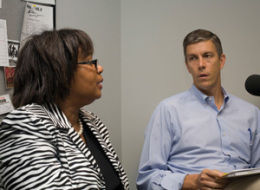
While I was startled that Obama made this pick, I think it was a good one. Duncan will do Obama's bidding without even having to be told what that is. He will be well-liked by pretty much everyone. And he will work to generally increase federal involvement where such involvement can make a difference, and will advocate strongly for "investment" in education in a way that will be convincing to most Americans.
(Direct quotes above are from http://www.time.com/time/politics/article/0,8599,1867011,00.html)
Subscribe to:
Posts (Atom)