This posting is a response to a piece published today in InsideHigherEd. I have also posted it as a comment in the thread of that article.
Dr. Porterfield is certainly correct that TFA should be supported. I think it offers an excellent opportunity for undergraduate students not in the traditional teacher education pipeline to become classroom teachers through a fairly comprehensive, �fast track�, alternative pathway. (And contra Ira and Jeremy, these are not either/or scenarios. There are already not enough �committed� teachers out there; that is why TFA exists. And while UCLA has a great program, it does not produce anywhere near the number of teachers that TFA does.) But this is exactly where Dr. Porterfield�s argument falls off the track. His fundamental argument is that higher education should partner with TFA to, among other things, better support prospective candidates such that they will become better candidates and better future teachers. But higher education already does that. It�s called teacher education. Georgetown University, Dr. Porterfield�s university, does not have a teacher education program. But they do have an excellent center called CNDLS�the Center for New Designs in Learning and Scholarship�that already supports graduate students and faculty in the teaching and learning process. And I dare say that there are multiple institutions in the greater DC area such that Georgetown students can get some very good teacher education courses under their belt. To suggest that higher education should somehow �partner� with TFA is to presume that there�s nobody out there already preparing teachers for urban and rural teaching. That is just plain silly. This line of reasoning falls squarely into the reductive and useless bickering over what it means to be a �highly qualified teacher.� One side says high standards and an infrastructure of professionalism; the other side says pretty much anything goes so long as candidates have high SAT scores and no criminal record (I know, I know, I�m simplifying. But anyone can do the research and get the details.) Moreover, Dr. Porterfield misses the critical point that TFA is explicitly not looking for teacher education candidates. So his suggestion for �partnerships� almost goes against TFA�s recruitment strategy. I might suggest, instead, that we more legitimately begin talking about partnerships between teacher education and TFA. Now that would be novel.
Friday, November 17, 2006

Wednesday, November 15, 2006
Nothing to do With Educational Policy, I Think
Given our recent discussions (both amongst ourselves and in this space) about blogging, I wanted to draw attention to Michael Berube's posting for today, which is based on a talk he just gave about blogging. (See also one take on his talk and Berube's comments.) What I found fascinating was that one of Berube's main points was that blogging was, almost by definition and in fact in much better relief than our resumes or syllabi or writings, who we are and what we do (thus his title of "Professors at Work"):
For all academic blogs, the big ones that get twenty thousand readers a day and the ones that get twenty friends stopping by, serve as representations of what professors do, in our variously high and low registers: we write introductions to �Signature Event Context� for our students, we ask each other about our courses and our students, we curl up with a good DVD now and then, and then we get online and we toss out a few thoughts, almost as if we�re at a dinner party or something. Some of us blog, as I do, about an hour or two a day; others, an hour or two a week. Some of us don�t take time away from our real work to do meaningless blogging, and some of us don�t take time away from important blogging to do other meaningless drivel. Because we think that in the end, academic blogs just might serve the useful function of representing to any interested Internet passerby just what it is we do with our time and our skills. For in all their high and low manifestations, our blogs depict professors at work.
This public face of our "half cooked" (the reference is to Berube's talk) perspectives, reactions, and intuitions offers a venue for exchange and networking, discussion, misunderstanding, and rethinking. It sharpens ideas, cools down others, and levels the "hierarchy of knowledge" so often invoked by academics. Heck, this does have to do with eductaional policy. Enjoy the read.
For all academic blogs, the big ones that get twenty thousand readers a day and the ones that get twenty friends stopping by, serve as representations of what professors do, in our variously high and low registers: we write introductions to �Signature Event Context� for our students, we ask each other about our courses and our students, we curl up with a good DVD now and then, and then we get online and we toss out a few thoughts, almost as if we�re at a dinner party or something. Some of us blog, as I do, about an hour or two a day; others, an hour or two a week. Some of us don�t take time away from our real work to do meaningless blogging, and some of us don�t take time away from important blogging to do other meaningless drivel. Because we think that in the end, academic blogs just might serve the useful function of representing to any interested Internet passerby just what it is we do with our time and our skills. For in all their high and low manifestations, our blogs depict professors at work.
This public face of our "half cooked" (the reference is to Berube's talk) perspectives, reactions, and intuitions offers a venue for exchange and networking, discussion, misunderstanding, and rethinking. It sharpens ideas, cools down others, and levels the "hierarchy of knowledge" so often invoked by academics. Heck, this does have to do with eductaional policy. Enjoy the read.
Sunday, November 12, 2006
Community Organizing and Urban Education, Part I: Introducing MOVE
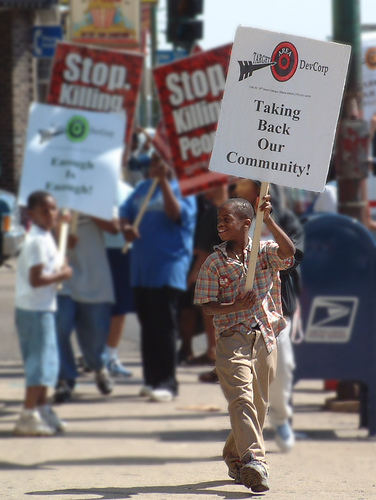
[To read the entire series, go here.]
For the last six years or so, I have worked with a local community organizing group on their Education Committee. MOVE (a pseudonym) is now one of a number of allied organizations in Wisconsin, and operates under the umbrella of the Gamaliel Foundation,which has local chapters in many different states (the other large organizing groups in America are the IAF, PICO, and ACORN). MOVE currently has 37 different congregations as members with a wide range of Christian and even a few non-Christian groups. (image)
I didn�t know anything about community organizing when I came to Milwaukee. But I had been studying a range of different theories of agency and democratic social action, and I was increasingly unsatisfied with what I found. At the same time as I was visiting the Unitarian church, looking for a community to join, I heard about MOVE, and was one of the people that encouraged the Unitarians to join. Soon after, I attended Gamaliel�s week-long leader training, where we were taught some basic concepts and language relevant to organizing. (I was yelled at and managed to completely embarrass myself). And I was hooked. This seemed like a potential avenue for actually fighting for social change instead of just chatting about it, and it also seemed to provide an opportunity to reach across Milwaukee�s sharp racial and class divide.
While I have been part of MOVE we have worked to increase the number of low class-size schools supported by the state in Milwaukee (we were quite successful). We fought against efforts to eliminate parents� rights to bus their children to non-neighborhood schools (almost single-handedly, MOVE forced the district to maintain these). And we worked on an effort to insure adequate funding for all schools (as I will describe later, this was a miserable�and predictable�failure). Currently we have shifted our focus a little and are working to improve health servMilwaukee Milwauk Public Schools (MPS). Just last week, we were instrumental in getting the state Department of Health and Family Services to put 27 new nurses in MPS schools (a three million dollar commitment), succeeding where a range of other groups have largely failed in their efforts over the last few years.
I plan to use this blog as an opportunity to write about my experience in MOVE: the good, the bad, and the ugly. I am writing as a researcher and as a participant, but it is important to emphasize that I have never made any effort to systematically conduct research on MOVE. These will be my personal reflections, drawing both on my experiences and on my broad reading about organizing.
In no particular order, topics I plan to discuss over the next few months include:
- Why churches? A different vision the church/state relationship
- How are organizing groups organized?
- Racial tensions (or, �white people can�t shut up�)
- Leadership training
- The language and key practices
- The ideal vs. the reality
- A different kind of democracy (or, �is this really democracy?�)
- What scholars can contribute
- Cutting an issue
- How to cut the wrong issue
- Alinsky, Reveille for Radicals. (The classic work about organizing from the iconoclastic organizer. Nearly all major organizing groups in America have emerged out of the Alinsky tradition.)
- Warren, Dry Bones Rattling. (A nice overview of how organizing has developed from Alinsky�s day.)
- Shirley, Community Organizing for Urban School Reform. (Even after ten years, still the best book on school-focused organizing.)
- Chambers, Roots for Radicals. (A more contemplative book by one of Alinsky�s key apprentices, now head of the national organization Alinsky founded, the IAF [Industrial Areas Foundation].)
- Ginwright, Noguera, and Cammarota (Eds.), Beyond Resistance. (Just published, and the first significant book on youth organizing.)
- Anyon, Radical Possibilities. (An extended argument about the importance of community action and broader economic change for effective school reform.)
Tuesday, November 7, 2006
Great job opportunity
Speaking of linking foundations to meaningful larger questions and issues, I just saw this job posting at University of Wisconsin, Milwaukee that links educational foundations with community engagement. Since Aaron and Raji (both bloggers on this site) are there and may feel uncomfortable saying it due to conflict of interest, I will say that their department looks like exactly the kind of place where foundations is flourishing and relevant. Their department chair, Ian Harris, wrote a very nice article that positions foundations as deeply linked to community education. And finally, speaking of jobs, there is a very interesting trend of using a wiki to track candidates� job interviews, visits, rejections, etc. I noticed numerous foundation-related jobs last year on it. The main academic page for all the disciplines is here.
Sunday, November 5, 2006
Educational Scholarship and Chiropractic Science
Improving classrooms and schools . . . [is] certainly helpful. But sadly, such activities may also be similar to those of the drunk found on his hands and knees under a street lamp. When asked by a passerby what he was doing, the drunk replied that he was looking for his keys. When asked where he lost them, the drunk replied �over there,� and pointed back up the dark street. When the passerby then asked the drunk why he was[n't] looking for the keys where they were located, the drunk answered �the light is better here!��Chiropractic practice is based on the assumption that spine adjustment has something to do with health. Chiropractors are committed to this practice regardless of the scientific data that emerges. The most that science can do for a chiropractor is help her improve what she already does. If science indicates that the best way to help a back-ache is medication, chiropractors can�t respond, because they don�t prescribe medication. At best, they can just send you to a doctor. But in most cases (in my experience) they just keep adjusting spines.
--David Berliner (2005, p. 2)
Scholarship in urban education depends similarly on the assumption that improved knowledge about theories and practices of instruction and school administration has something to do with improving student achievement and students� life chances in a broad range of areas. When scholars like David Berliner and Jean Anyon tell us that unless we first improve the material situations of inner city communities, school-based efforts are unlikely to have much effect on student achievement or success, most of us aren�t sure how to respond. Those of us who find these arguments compelling may nod our heads wisely in agreement. But then, usually, we just go back to doing what we were doing before.
What else can we do? The trajectory of our careers and the very structures of the institutions we work within are designed around the assumption that academic achievement and joblessness, among many other issues, are fundamentally instructional problems. There are few significant avenues within our world for responding to the idea that, in important ways, this assumption may be fundamentally flawed.
If we teach science ed then it seems obviously true that our research ought to be about better ways to teach science. If our focus is on reading, then it seems obviously true that our research ought to be about improving reading instruction. If we teach students how to be leaders, then it seems obviously true that our research ought to examine teacher leadership.
(My point is not, of course, that we shouldn�t keep working to improve schools. Without this work, conditions in the central city would almost certainly be much worse. But if Anyon and Berliner are right (and I think they are) then these efforts accomplish, on a practical level much less than we would like to think they do.)
It immediately seems ludicrous to me that most of what we try to do to help poor youth is classroom and school based.There are a few examples of efforts within the field to respond to the limitations of our usual ways of approaching �school� problems. Efforts to develop full-service schools, for example, seek to address the fact that many children don�t learn effectively because of incredibly basic health problems. (As Berliner notes, an astonishing 50% of poor children have significant untreated vision problems). Similarly, efforts to change the horrible nutritional quality of inner-city students� diets have been directly linked to achievement increases.
--David Berliner (2005, p. 3)
Others (including Anyon and Berliner) have looked look to possibilities for improved community participation as important avenues for resisting the forces that oppress urban communities. But, again, because these concerns take scholars outside the standard boundaries that mark the limits of �educational� research, these efforts also remain mostly marginal to the field.
Part of the problem with calls to action like those of Anyon and Berliner is that they say much about the limits of our current approaches, but little or nothing about how we might change the institutional structures that maintain our traditional focus despite their compelling data.
The key challenge for us, today, then, is �school of education heal thyself.� Until we alter the structure of the systems we are imbedded in so that we can actually hear and practically respond in coherent ways to the limitations of our current approaches, little change is likely to happen.
To link this to our ongoing discussions on this blog: what better place to begin efforts to look beyond traditional understandings of the role of educational scholarship than in foundations? Foundations represents one of the few areas of the field that consistently focuses on the importance of looking broadly at the relationships between schooling and society. Even for us, however, bringing these �extra-instructional� issues into our purview would require radical changes in the ways we currently conceptualize ourselves�changes in what we teach, what we study, who we hire, and who we serve.
I�m not holding my breath. �Straightening spines� (improving traditional forms of instruction) is what we were trained to do, it�s what we are expected to do, and it fits coherently within the kinds of educational and scholarly contexts we are most likely to find ourselves. If Anyon and Berliner are right, however, this means the vast majority of us will likely continue to ignore the central challenges that prevent those who are most marginalized in America from succeeding in school and in life.
The Information Gap on Affirmative Action
Here is an example of a foundations scholar many of us know well, Michele Moses of Colorado, and a graduate student there, engaging an issue (affirmative action in Michigan) of critical importance in a widely read venue, hence I bring it to our blog.
Wednesday, November 1, 2006
Nothing to Fear but Fear Itself: The Future of Teacher Education
If it wasn�t scary enough to go trick-or-treating last night, then it is certainly scary to read two op-ed pieces which came out yesterday. (Thanks to the eduwonk for always being on top of this one.) One was by Arthur Levine and the other by Jay Mathews. Arthur Levine is pounding the pavement for his recent study; he has published nearly identical articles here and here. The key, argues Levine, is to create higher standards for education schools, accrediting committees, and state boards such that we can tame the �wild west.� This is the standards side of the debate about teacher education, which is aligned with Linda Darling Hammond�s longstanding argument that teaching is fundamentally a profession and as such analogous to the professional preparation and standards of medicine and law. See Marilyn Cochran-Smith�s nice summary of the debate (even if a little dated by now). Mathews, an education columnist for the Washington Post (he has a weekly column, �Class Struggle�), provides a seemingly neutral description of Levine�s study. He throws in contrasting perspectives, summarizes some of Levine�s main buzzwords and suggestions, and lays out the contrary side of the debate in the form of alternative licensure programs such as Teach for America. (I must take issue with his characterization of TFA as providing �minimal preparation.� Check out TFA�s summer institute and their manuals [by request from TFA]. It is pretty intense and more comprehensive than many education school programs that I have seen and been a part of. Disclosure: I worked for TFA 15 years ago.) But what Mathews is really doing is adding yet another brick in the wall of his overarching argument that education schools are out of touch and irrelevant to truly make a difference in the lives of students (especially urban youth). (See a good example of that here.)
So what�s scary about all of this? Just like Halloween, it is not the fake ghosts and goblins, but the fact that you eat way too much candy. The scary part of such arguments and attacks are not the fake problems (e.g., professors out of touch, curriculum irrelevant, etc.). For goodness sake, hospitals accidentally kill 1000,000 people a year (according to the Institute of Medicine�s conservative estimate). And the legal profession?? Do you really want to go down that path? The argument for higher standards is in general a good one, but it is a setup to presume that once we have high standards we will have great teachers. There are bad doctors and bad lawyers and there will be bad teachers. And I�m not even going to go down the path of attempting to justify standards vis-�-vis the preponderance of evidence that shows miniscule statistical support for licensure positively impacting student outcomes (see the comments thread of a previous post of mine for more discussion of the problems of basing �quality� on long-term student outcomes).
The scary part is that such attacks continue the useless �art versus science� argument about teacher education. Levine argues it is a science (=a profession). And Mathews implies it is an art that can be done with �minimal preparation.� This latter argument is one of the bedrock principles of the alternative licensure movement, allowing potential teachers to avoid educational coursework in many states (see the recent Secretary�s 5th Annual Report on Teacher Quality for the detailed numbers; I�ll be blogging about this one soon enough). So, just like yesterday�s Halloween, the argument is an either/or. Either we don�t eat candy or we eat way, way too much. And in education, it seems, either we have standards or we don�t. But this is just plain silly. Teacher education requires the opportunity to learn (coursework), the opportunity to practice (field-based practicum), and the opportunity to change (self-reflection of oneself as learner and teacher). Where this happens, from my perspective, is more or less irrelevant so long as it does happen. The complexity and challenge and the heart of preparing teachers is to figure out how to do all three aspects well. To simply have one or two of these doesn�t do justice to the complexity of teaching. It just lets all those hobgoblins keep on writing op-ed pieces.
So what�s scary about all of this? Just like Halloween, it is not the fake ghosts and goblins, but the fact that you eat way too much candy. The scary part of such arguments and attacks are not the fake problems (e.g., professors out of touch, curriculum irrelevant, etc.). For goodness sake, hospitals accidentally kill 1000,000 people a year (according to the Institute of Medicine�s conservative estimate). And the legal profession?? Do you really want to go down that path? The argument for higher standards is in general a good one, but it is a setup to presume that once we have high standards we will have great teachers. There are bad doctors and bad lawyers and there will be bad teachers. And I�m not even going to go down the path of attempting to justify standards vis-�-vis the preponderance of evidence that shows miniscule statistical support for licensure positively impacting student outcomes (see the comments thread of a previous post of mine for more discussion of the problems of basing �quality� on long-term student outcomes).
The scary part is that such attacks continue the useless �art versus science� argument about teacher education. Levine argues it is a science (=a profession). And Mathews implies it is an art that can be done with �minimal preparation.� This latter argument is one of the bedrock principles of the alternative licensure movement, allowing potential teachers to avoid educational coursework in many states (see the recent Secretary�s 5th Annual Report on Teacher Quality for the detailed numbers; I�ll be blogging about this one soon enough). So, just like yesterday�s Halloween, the argument is an either/or. Either we don�t eat candy or we eat way, way too much. And in education, it seems, either we have standards or we don�t. But this is just plain silly. Teacher education requires the opportunity to learn (coursework), the opportunity to practice (field-based practicum), and the opportunity to change (self-reflection of oneself as learner and teacher). Where this happens, from my perspective, is more or less irrelevant so long as it does happen. The complexity and challenge and the heart of preparing teachers is to figure out how to do all three aspects well. To simply have one or two of these doesn�t do justice to the complexity of teaching. It just lets all those hobgoblins keep on writing op-ed pieces.
Subscribe to:
Posts (Atom)